Reading time:
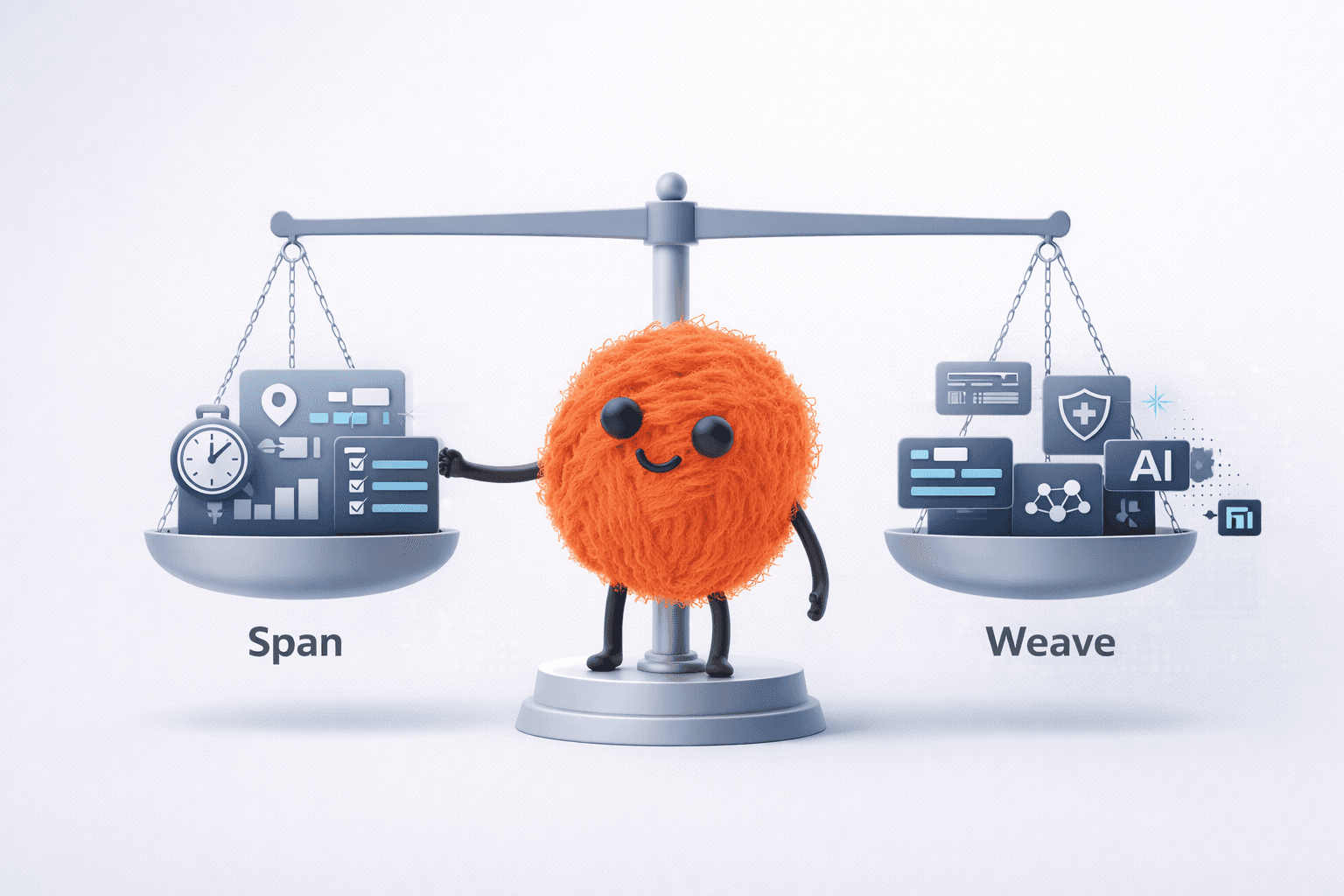
Weave vs. Span

Article written by
Brennan Lupyrypa
The Challenge of Measuring Modern Engineering Teams
Trying to get a clear picture of how your engineering team is really doing can feel like a shot in the dark. For years, we've relied on surface-level metrics like commit counts or the number of tickets closed. But let's be honest, those numbers don't tell you much about the quality, complexity, or actual impact of the work.
This is where engineering analytics platforms come in. They promise to bring clarity to the software development lifecycle. Two solutions you might be looking at are Weave and Span. Both aim to provide deeper insights, but they go about it in fundamentally different ways.
This article will compare both platforms to help you choose the right tool for your team. We’ll dive deep into how Weave engineering analytics provides a level of insight that traditional tools can't match.
What is Weave? AI-Powered Engineering Intelligence
Weave is a next-generation engineering analytics platform that uses AI to give you a holistic, contextual view of your engineering team's work. We believe that to truly understand performance, you have to move beyond simple activity tracking and get to the why behind the data. You need to understand the work's complexity, its quality, and its impact on the business. That's the core of a modern guide to AI-driven engineering analytics.
Weave, founded by Adam Cohen and Andrew Churchill, was built to bring objective performance measurement to engineering [1].
Here are a few key features that set Weave apart:
AI-Driven PR Scoring: Weave evaluates every single pull request on three core pillars: Speed, Quality, and Collaboration. This gives you a balanced view of performance, not just how fast code is merged.
Objective Output Measurement: Using a proprietary machine learning model, Weave assesses engineering effort with a remarkable 0.94 correlation to actual output, making it far more reliable than old-school metrics. You can read more about how this compares to other platforms in our Weave vs Jellyfish analysis.
AI Impact Intelligence: In today's world, you need to know if your investment in AI tools is paying off. Weave measures exactly how AI tools are improving your team's shipping velocity and tracks the real ROI.
Weave is built for everyone on a modern engineering team—from an individual engineer who wants to see their growth path to a CTO who needs to make high-stakes strategic decisions. Our platform uses AI to measure AI, giving you unparalleled visibility.
What is Span?
Span is a capable engineering analytics platform that excels at providing clear, comprehensive dashboards. Its approach is generally based on established industry frameworks like DORA (Deployment Frequency, Lead Time for Changes, etc.) and the SPACE framework.
Span’s primary use case is helping managers monitor team-level performance, track project velocity against timelines, and identify process bottlenecks. It's great for getting a high-level operational overview of your teams. However, this approach provides a valuable but broad view that may lack the deep, AI-driven contextual analysis of individual work quality and complexity that modern teams need.
Weave vs. Span: A Head-to-Head Comparison
So, how do these two platforms really stack up? It comes down to their core philosophy and what they're designed to measure.
Core Methodology: AI Context vs. Traditional Metrics
Weave: Weave uses Large Language Models (LLMs) and domain-specific machine learning to analyze the actual work being done—the code, the comments, the reviews. It assesses the complexity and quality of every contribution to provide an objective measure of output. This is how Weave is replacing subjective measures like story points with objective, data-driven insights.
Span: Span's approach is rooted in tracking established process metrics. It’s excellent at showing you what is happening and how fast it’s happening (e.g., cycle times, deployment frequency). The limitation is that it doesn’t always explain why something is happening or the quality of the work behind the numbers.
Primary Focus: Individual Empowerment vs. Team Monitoring
Weave: We see Weave as a "personal feedback engine" for every engineer. It’s designed to provide actionable, individual insights that help developers understand their strengths and identify areas for improvement. This fosters a culture of continuous growth and helps you retain top talent, which is a key differentiator when comparing Weave vs. other platforms.
Span: Span is built primarily for managers and executives. Its focus is on team and organizational-level performance, resource allocation, and tracking high-level KPIs. It answers the question, "Is the team on track?" but not necessarily, "How can each person on my team become a better engineer?"
Measuring the Impact of AI
Weave: This is where Weave truly shines. It has the unique ability to measure AI adoption and calculate the ROI on your AI development tools. Weave can identify AI-generated code, track its quality, and quantify the productivity gains your team is seeing. For managers wondering how to measure this new frontier, Weave provides clear answers).
Span: Traditional analytics platforms like Span are often not equipped to differentiate between human-written and AI-generated code. This leaves a critical blind spot for modern teams that are increasingly leveraging AI assistants, making it difficult to understand their true impact.
Comparison Table: Weave vs. Span at a Glance
Feature | Weave | Span |
|---|---|---|
Core Methodology | AI & ML analysis of work quality and complexity | Traditional process metrics (DORA, SPACE) |
Primary Focus | Individual engineer growth and empowerment | Team and organizational process monitoring |
Key Differentiator | AI impact tracking and ROI calculation | Comprehensive dashboards for process efficiency |
Code Analysis | Deep analysis of code quality and review effectiveness | Surface-level activity tracking (commits, PRs) |
Ideal User | Leaders fostering a growth culture; AI-adopting teams | Managers focused on high-level process compliance |
Conclusion: The Future of Engineering Analytics is AI-Driven
So, which tool is right for you?
Span offers a solid foundation in traditional process metrics, giving you a good high-level view of operational efficiency. It’s a reliable choice if your primary goal is to monitor established KPIs.
However, Weave represents the next evolution in engineering intelligence. As software development becomes more complex and AI becomes more integrated into our workflows, simply tracking activity is no longer enough. You need to understand the quality and impact of the work itself.
If you’re a forward-thinking leader who wants to empower your individual developers, measure the true ROI of your tools, and build a culture of data-driven excellence, then Weave is the clear choice. It provides the deep, contextual insights that are essential for navigating the future of software engineering, as highlighted in our guide to engineering intelligence platforms.
Ready to move beyond basic dashboards? See how Weave can give you a true measure of your team’s performance.
Meta Description
Compare Weave vs. Span and see why AI-powered Weave engineering analytics provides a truer measure of developer growth and team performance.
Citations
[1] https://www.ycombinator.com/companies/weave-3
Links
https://workweave.dev/blog/weave-vs.-waydev-which-engineering-analytics-platform-is-right-for-you
Article written by
Brennan Lupyrypa

Make AI Engineering Simple
Effortless charts, clear scope, easy code review, and team analysis